Mortgage Rates Rise Above 7% As Iran War Approaches its Ninth Month
Mortgage rates are back above 7% as the Iran war nears its ninth month. Here’s why rates are going up, what it means for real estate investors, and whether mortgage rates will go down in 2027.
Published Nov 20, 2026
By Christa Niemann
This week on the Breakdown, we discuss the conflict in Iran and its continuing effects on mortgage rates and the U.S. housing market more generally. We’ll take a close look at what’s happening in Iran, how the war has shaped the trajectory of mortgage rates in 2026, and what’s to come for the 2027 housing market if the war continues.
Why Are Mortgage Rates Going Up?
Mortgage rates are going up mainly because the Iran war has pushed up oil prices, inflation, and 10-year Treasury yields, three of the biggest forces that move mortgage rates.
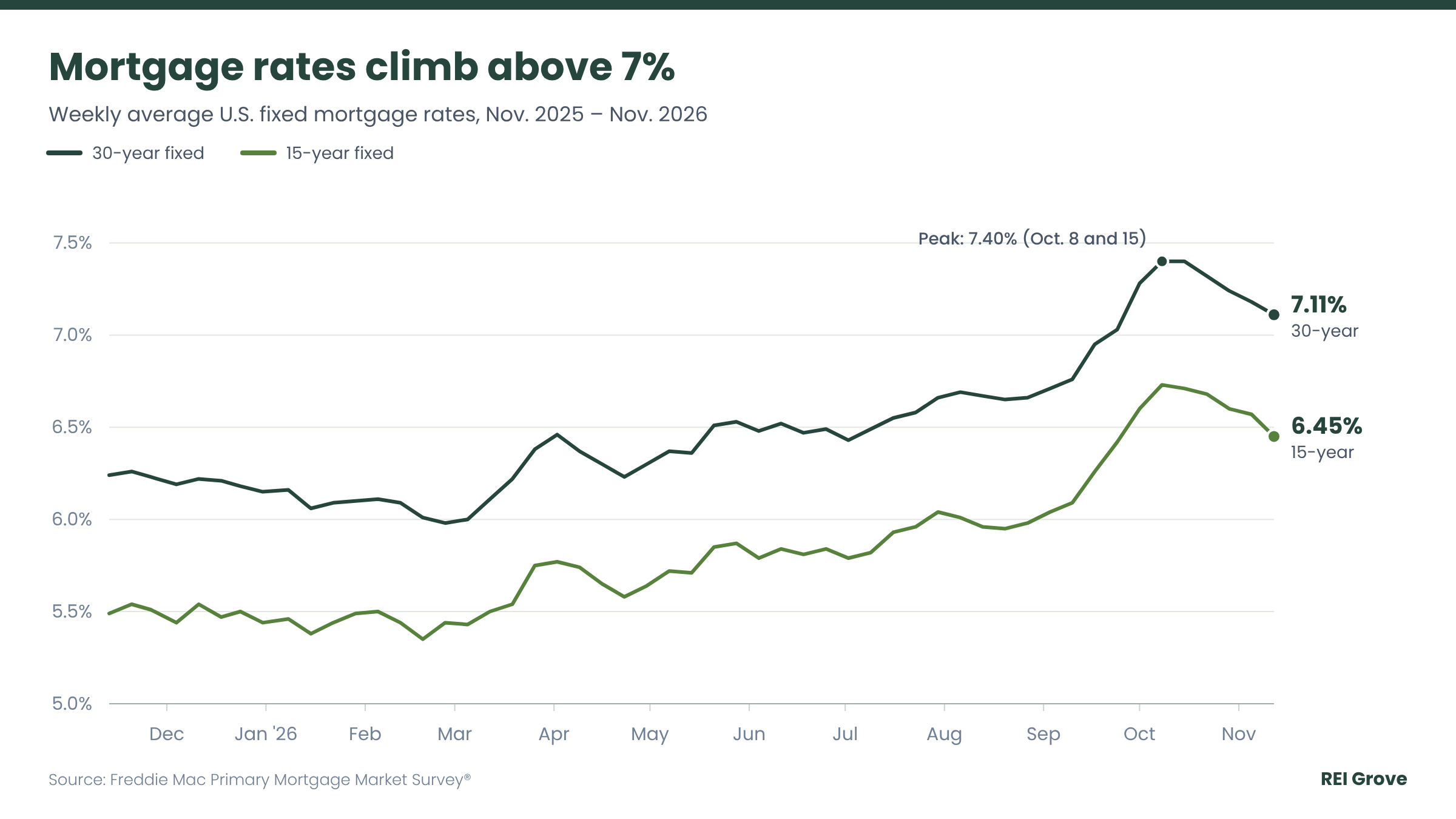
Since the war in Iran started at the end of February, mortgage rates have been reaching higher—and they just jumped back over 7%. As of the week of November 12th, Freddie Mac’s 30-year mortgage rates sit at 7.11% while their 15-year mortgage rates sit at 6.45%, dipping slightly from their October peak of 7.40% and 6.73% respectively.
Before the war began, rates had dropped just below 6% for the first time in three years. After the conflict broke out and oil supply was disrupted, fears of shortages pushed the price per barrel of oil up, and thus, the rate of inflation in the U.S. In February, inflation sat at about 2.4%, and since the war started, the rate has not fallen back under 3%, sitting at 3.7% today.
Additionally, ten-year Treasury yields are a major benchmark for mortgage rates. When the market value of T-notes begins to fall, the yield rate increases, which in turn increases 30-year mortgage rates. The two rates follow each other very closely. After the tensions in the Middle East broke out in late February, Treasury yields began to rise, moving from 3.96% in February to 5.06% in mid-November.
The war has continued for almost nine months, disrupting the country’s economy as time has gone on. We wrote about the conflict and its potential effects back in July, predicting that mortgage rates may continue to rise if the war continued long-term; unfortunately, that seems to be the case as the 30-year rate has climbed nearly half a point since late July, when it sat a 6.66%.
Mortgage Rates in 2026: A Timeline
Mortgage rates started 2026 on a hopeful note. January’s rates started off the year at 6.16%, and in February, the 30-year mortgage rate dropped to 5.98%. These rates coincided with the affordable housing push across the country, with bipartisan affordable housing bills passing the house and senate.
After the conflict began, rates jumped drastically as oil movement halted in the Strait of Hormuz and people began to panic. In April, rates peaked at 6.46% before dropping slightly. The messaging from the White house was unclear during this time as ceasefires were called and then broken, fueling the panic further.
As the U.S. settled into the war being longer-term than hoped, rates steadily increased throughout the rest of the year, eventually climbing back above 7% in late September, where they have stayed since. Rates hit their highest point of the year in October, when the 30-year interest rate reached 7.4%.
Currently, that rate sits at 7.11% (7.46% according to Mortgage News Daily), but with the war in Iran still not over yet, it’s not likely that rates will significantly decrease any time soon.
Here's how Freddie Mac's average 30-year and 15-year fixed mortgage rates have moved in 2026, using the first weekly reading of each month (plus the latest reading for November)
Week of (2026) | 30-year fixed | 15-year fixed |
Jan. 8 | 6.16% | 5.46% |
Feb. 5 | 6.11% | 5.50% |
Mar. 5 | 6.00% | 5.43% |
Apr. 2 | 6.46% | 5.77% |
May 7 | 6.37% | 5.72% |
June 4 | 6.48% | 5.79% |
July 2 | 6.43% | 5.79% |
Aug. 6 | 6.69% | 6.01% |
Sept. 3 | 6.71% | 6.04% |
Oct. 1 | 7.28% | 6.60% |
Nov. 5 | 7.18% | 6.57% |
Nov. 12 | 7.11% | 6.45% |
Source: Freddie Mac Primary Mortgage Market Survey
Latest Iran War Developments (November 2026)
Tensions have been high recently due to a rumor spread by former FOX News host Tucker Carlson accusing President Trump of considering nuclear attacks on Iran. While this prediction has not come to fruition, it has heightened the general public’s stress about the conflict and called attention back to the Middle East.
Additionally, despite President Trump promising in September to end the war after the November midterms, the war continues on, with the U.S. striking Qeshm Island in the Strait of Hormuz on the 6th and Iran retaliating by striking Kuwait on the 18th. These actions have made Congress Democrats consider using a government shutdown to force Trump to end the conflict, wanting to force language into government funding bills that would require an end to the strikes in Iran.
The bottom line is that the war has not improved and has no signs of ending soon, despite public outcry from voters and politicians alike calling for an end to the fighting. As of today, the Strait of Hormuz is still closed, a ceasefire has not been called, and proxy wars continue with Yemen, Lebanon, and Iraq.
How Higher Mortgage Rates Affect Real Estate Investors
As any investor, landlord, or homebuyer knows, higher mortgage rates mean worse deals on properties—sometimes significantly so.
For example, if you were looking to buy a $500,000 property in February of 2026, your first monthly interest charge on a 30-year mortgage would be ~$2,491.67 (assuming a $500,000 loan at February's 5.98%).
If that same property were purchased in October, your first month’s interest would be ~$3,050.00 (at a 7.32%). That’s an almost $560 increase from February to October. For some rental businesses, several hundred dollars may be an easy payment, but for small business owners or first-time landlords, it can be the difference between possible and impossible.
Mortgage Applications Are Falling
According to the Mortgage Bankers Association (MBA), mortgage application activity has decreased 2.3% adjusted seasonally (5% if unadjusted) in the past week alone. These higher rates are pushing out homebuyers across the country, putting another obstacle in their way and hurting the housing industry further.
Since the rates have fluctuated and increased so much over the course of this year and this war, now may not be the most ideal time to expand your portfolio for your rental business. This isn’t the most advantageous market, but if a good deal comes along that would financially benefit your business, it’s always a good idea to take it.
Will Mortgage Rates Go Down? What to Expect in 2027
There is still no clear path for the future of mortgage rates in America as the war continues and inflation keeps rising. The 30-year mortgage rate in November of 2025 was 6.24%, and in November 2026 it’s almost a full point higher at 7.11%. If the war becomes a “forever war,” these rates could continue to fluctuate and trend higher.
If the war concludes soon and oil supply stabilizes, inflation rates and Treasury yields may begin to move in the right direction, with mortgage rates following suit. Even so, we may not see rates decrease to pre-Iran levels for a very long time. Until then, your best option is to stay as informed as possible and as educated on your finances as you can. Only you know your rental business’ readiness to expand. When a purchase feels right, you’ll be able to make an informed decision.
FAQs
Why have mortgage rates increased in 2026?
Mortgage rates have risen largely due to the ongoing Iran war, which has disrupted oil supplies, increased inflation, and pushed 10-year Treasury yields higher.
What are current mortgage rates as of November 2026?
According to Freddie Mac, the average 30-year fixed mortgage rate is 7.11%, while the 15-year rate is 6.45% as of November 12, 2026.
Will mortgage rates go down in 2027?
Mortgage rates are unlikely to go down significantly while the Iran war continues, but a resolution could help rates ease over time.
What affects mortgage rates?
Mortgage rates are driven largely by inflation and 10-year Treasury yields, both of which have risen during the Iran war.
How do Treasury yields affect mortgage rates?
30-year mortgage rates closely follow the 10-year Treasury yield, so when yields rise, mortgage rates usually rise too.
How has the Iran war affected the U.S. housing market?
The conflict has contributed to higher mortgage rates, making homes more expensive to finance and discouraging some buyers from entering the housing market.
How much have mortgage rates increased since the war began?
Before the conflict began in February 2026, 30-year mortgage rates had fallen to 5.98%. By November, they had climbed to 7.11%.
Is now a good time to buy rental property?
Higher interest rates make financing more expensive, so investors should carefully evaluate purchase prices, financing costs, and potential rental income before buying rental property.
How have higher mortgage rates affected homebuyer demand?
Higher monthly borrowing costs have made homeownership less affordable, contributing to a decline in mortgage application activity and pushing some buyers out of the market.